
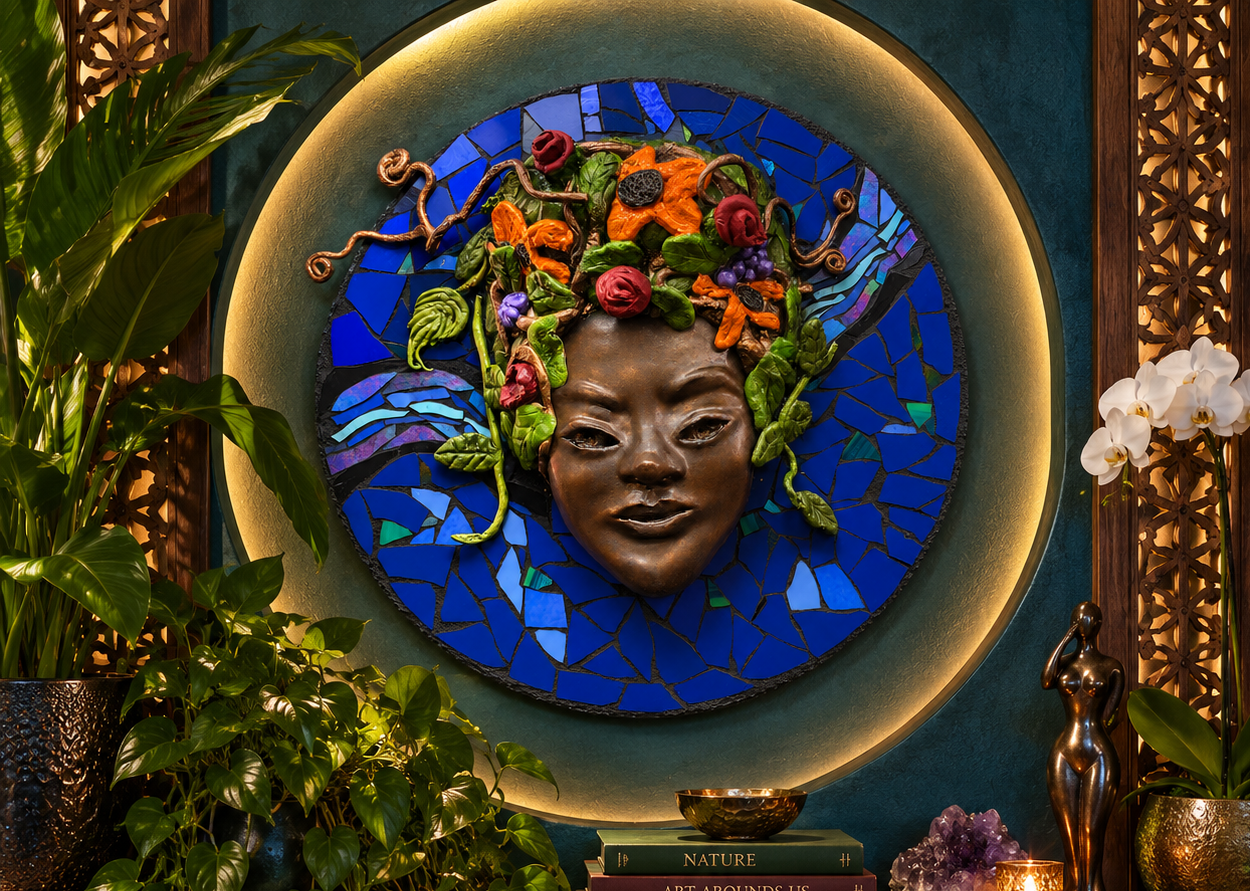
Earth
Grounding
Earth explores Grounding through nourishment, abundance, balance, and growth.
Earth was the first Celestial Face I created.
I associated Earth with Grounding because Earth has always felt like mother energy to me—steadiness, security, belonging, and nourishment. The association between Earth and motherhood is ancient, and it felt like a natural place for me to begin.
That led me toward a face with feminine energy, although I didn't want her to feel delicate or ultra-feminine. I wanted strength and steadiness in her expression, but strength that came from a nourishing, accommodating place rather than a hard or domineering one.
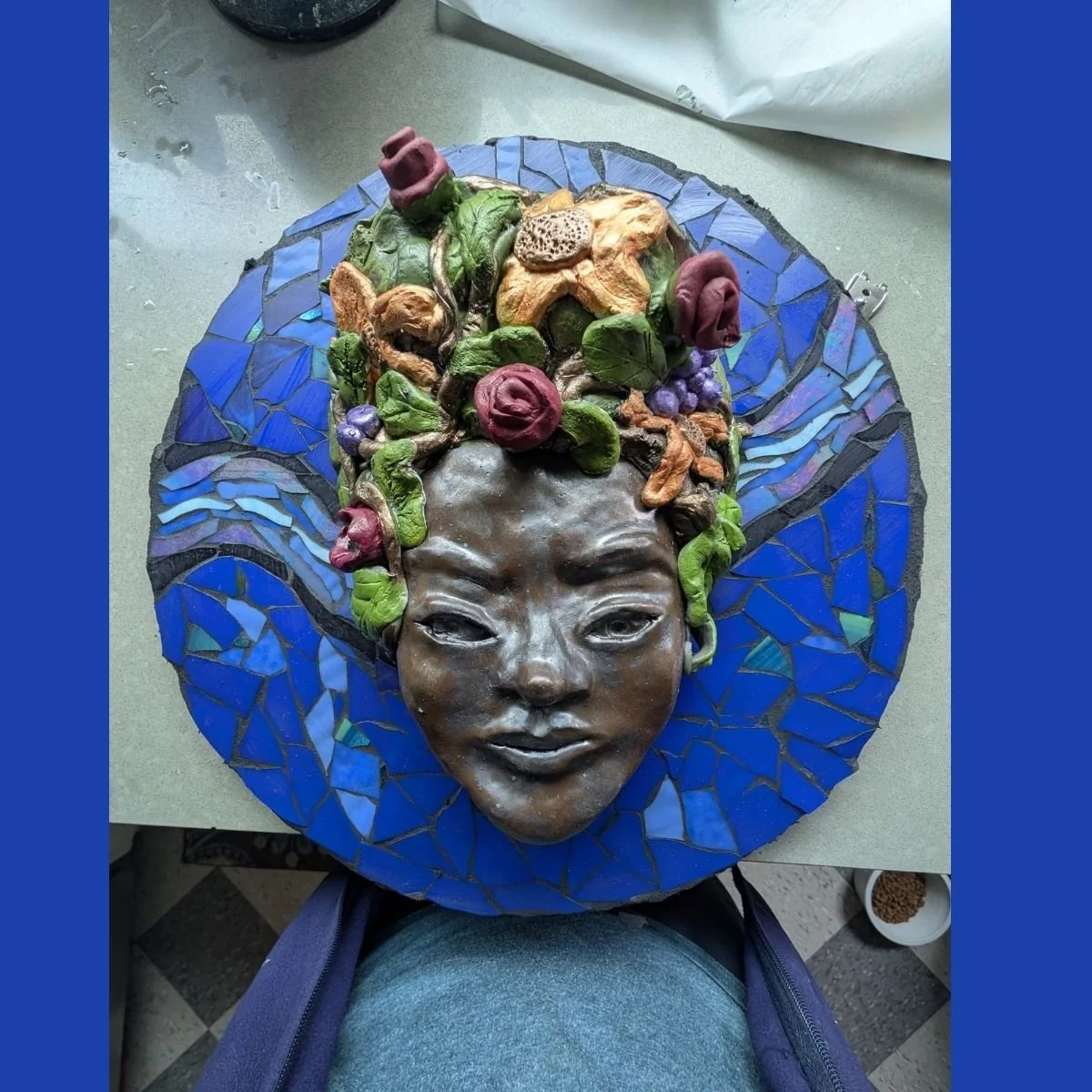
The clay had other ideas. When I couldn't get the clay to become the solid mass of vegetation I'd imagined, I began forming individual leaves, flowers, vines, and berries from epoxy clay instead. Like vegetation itself, the idea grew as the form grew.
I'm a balance seeker, so every so often I would stop sculpting and step back to look at the whole head. I began thinking about it almost as though I were tending a garden: Which areas needed watering and fertilizing? Which ones needed pruning and controlling?
I went back and forth between adding and restraining until it felt both abundant and balanced.
What emerged was something I hadn't originally planned: lush stability.
When the Plan Changed
I sculpted the ceramic face largely according to plan. The vegetation was another matter.
My original idea for Earth's hair was a dense mass of green vegetation—something like an Afro made from a thick, continuous hedge. I could see it clearly in my head.
A stream of glass begins in the upper right of the composition, passes through Earth's temple, and emerges through the opposite cheek. I liked the way it allowed the face and surrounding mosaic to remain visibly different while physically moving through one another.
Water, Movement and the Blue Planet
I built the surrounding mosaic primarily from deep blue stained and art glass, with lighter blues, blue-greens, iridescent pieces, mirror, and metallic glass mixed throughout. I didn't want the blue to be uniform.
And Then Came the Bee
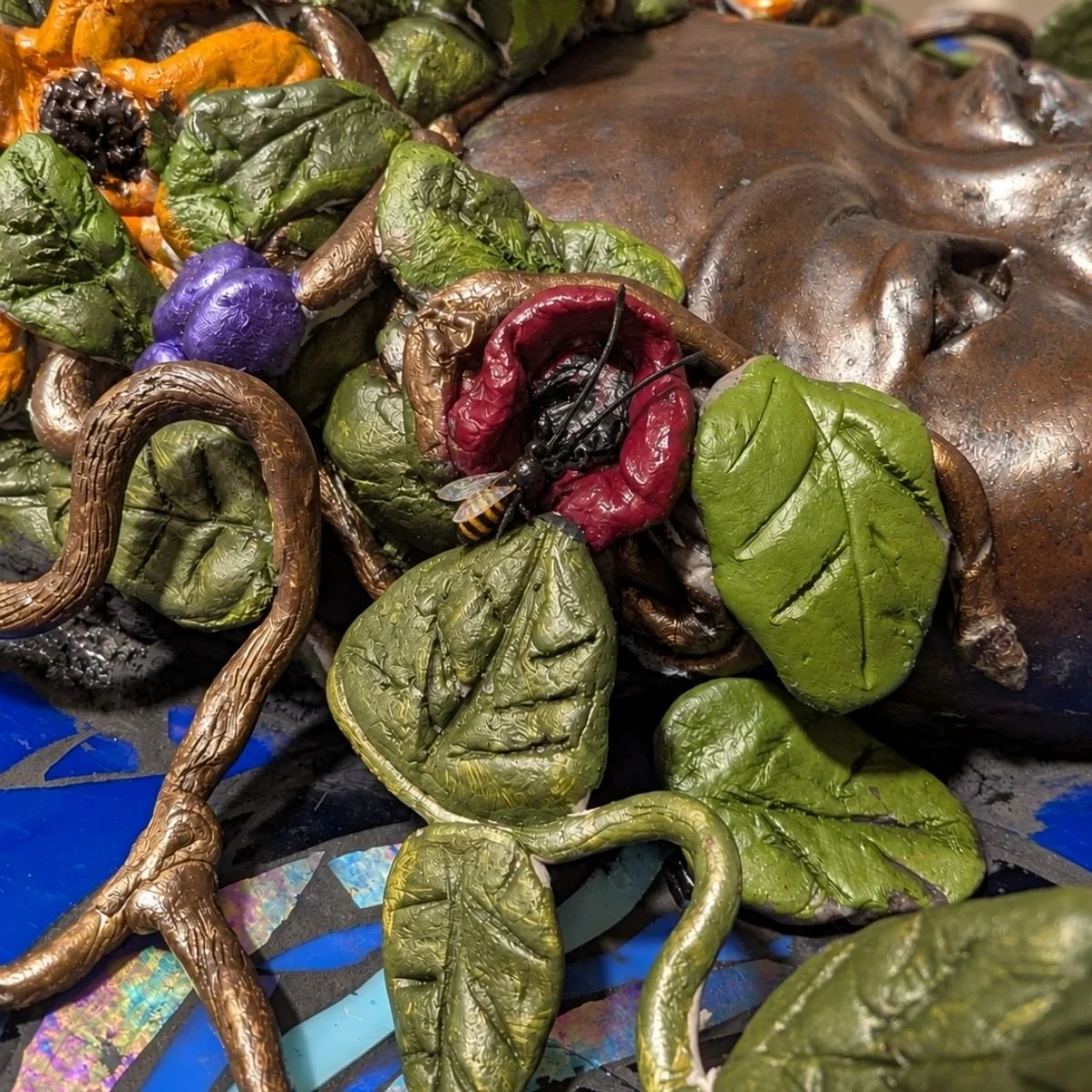
The bee wasn't part of the plan either.
Someone looking at the sculpture mentioned “flora and fauna,” and I suddenly realized that I had created an abundance of flora without including a single animal.
So I made a tiny bee and gave it shiny paper wings.
You have to look fairly closely to find it.
A Very Sticky Lesson
Earth also gave me a memorable introduction to two-part epoxy adhesive.
The ceramic face, epoxy-clay vegetation, and substantial wood backer made this a fairly heavy object, and I wanted the face securely attached. I used several methods: a mechanical connection that allows the face to hang from a screw, the adhering properties of the epoxy-clay headdress, and two-part epoxy adhesive.
I had used two-part epoxy clay before, which I mixed with my hands. So when I encountered two-part epoxy adhesive for the first time, I did what seemed perfectly logical.
I mixed Parts A and B with my bare hands.
This was not a good idea.
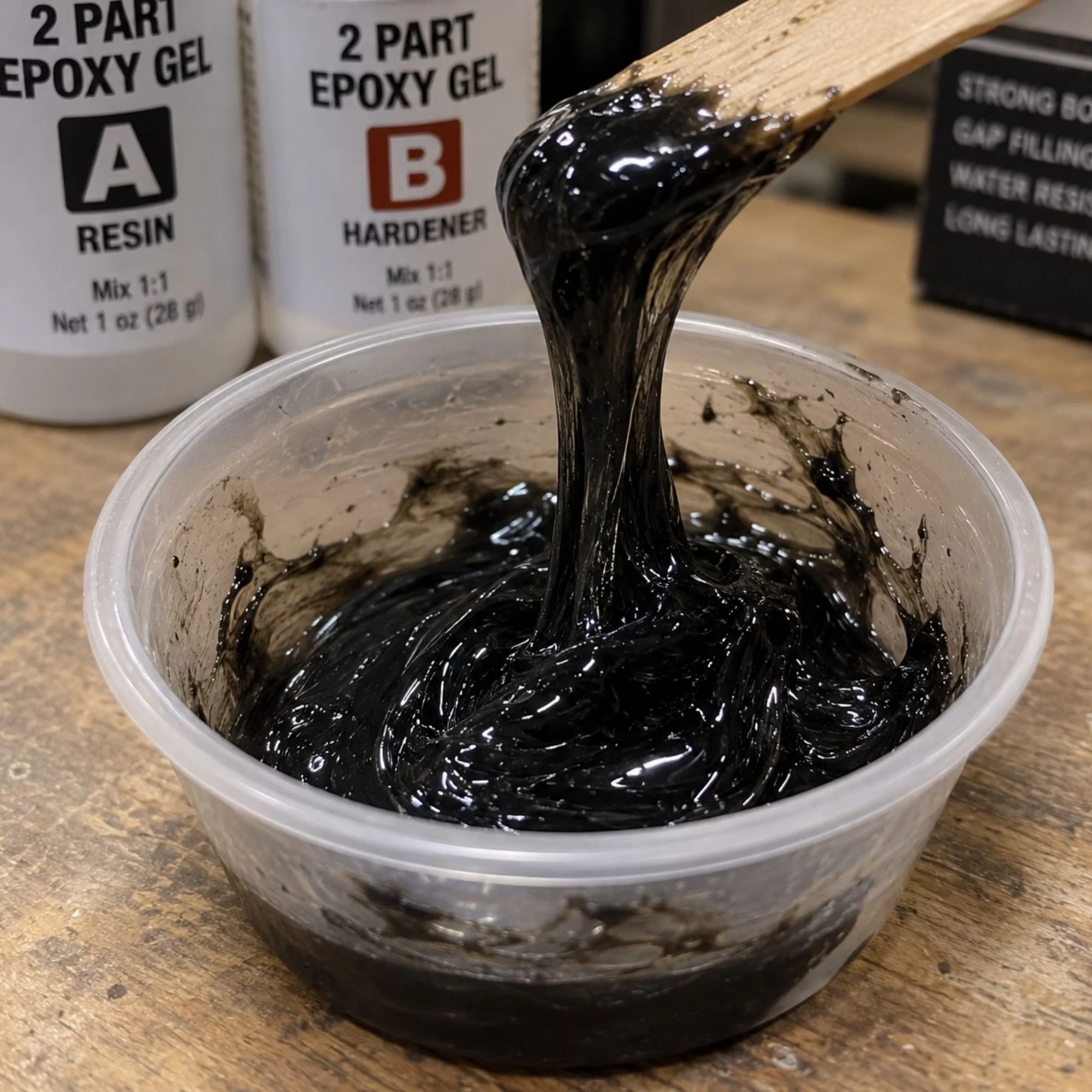
I eventually got the face securely attached—and got myself unstuck. By the time I attached the next Celestial Face, my supplies included gloves, a mixing cup, a stick, plenty of paper towels, and water nearby.
The First Face
Earth was the first time I discovered that I didn't need to illustrate a planet literally.
I could start with an idea—Grounding—and draw from the physical characteristics of Earth, the meanings humans have associated with it, and my own experience, then let the face, materials, color, texture, and form take it from there.
I was still new to clay. I was learning what the materials could do, what they wouldn't do, and when abandoning my original plan could lead somewhere more interesting.
Earth didn't give me a formula for the Celestial Faces that followed.
It gave me permission not to have one.